
Agentic Engineering with Claude Code: From First Feature to Quality Pipeline
Coding agents make code cheap; trust is still expensive. Learn to ship features with an agent that you can prove are right: tests first, real gates.
💡 Why this course
Because writing code is no longer the hard part. Trusting it is.
A coding agent can produce in an afternoon what used to take a week. That changes the question teams ask. It is no longer “how fast can we build this?” but “how do we know this is right?”. Confident code, green builds that test nothing and pull requests nobody can really review are the new risk, and they arrive faster than ever.
We believe testers and developers who can answer that question will be the most valuable people in every team that uses AI. Not by writing less code by hand, but by being the ones who decide what “done” means and make the agent prove it.
🧭 How you learn it
- One real project, start to finish. Every lesson works on the open example repository TestRun Board, with worked solutions on branches, so you can compare your result with ours.
- Prove it, do not trust it. Tests come first, failures are checked for the right reason, and hooks, CI gates and mutation testing catch what a summary hides.
- Rules where they hold. You learn what belongs in context, what in a skill, and what must be enforced by a hook or a pipeline, so it works for every team member and every agent.
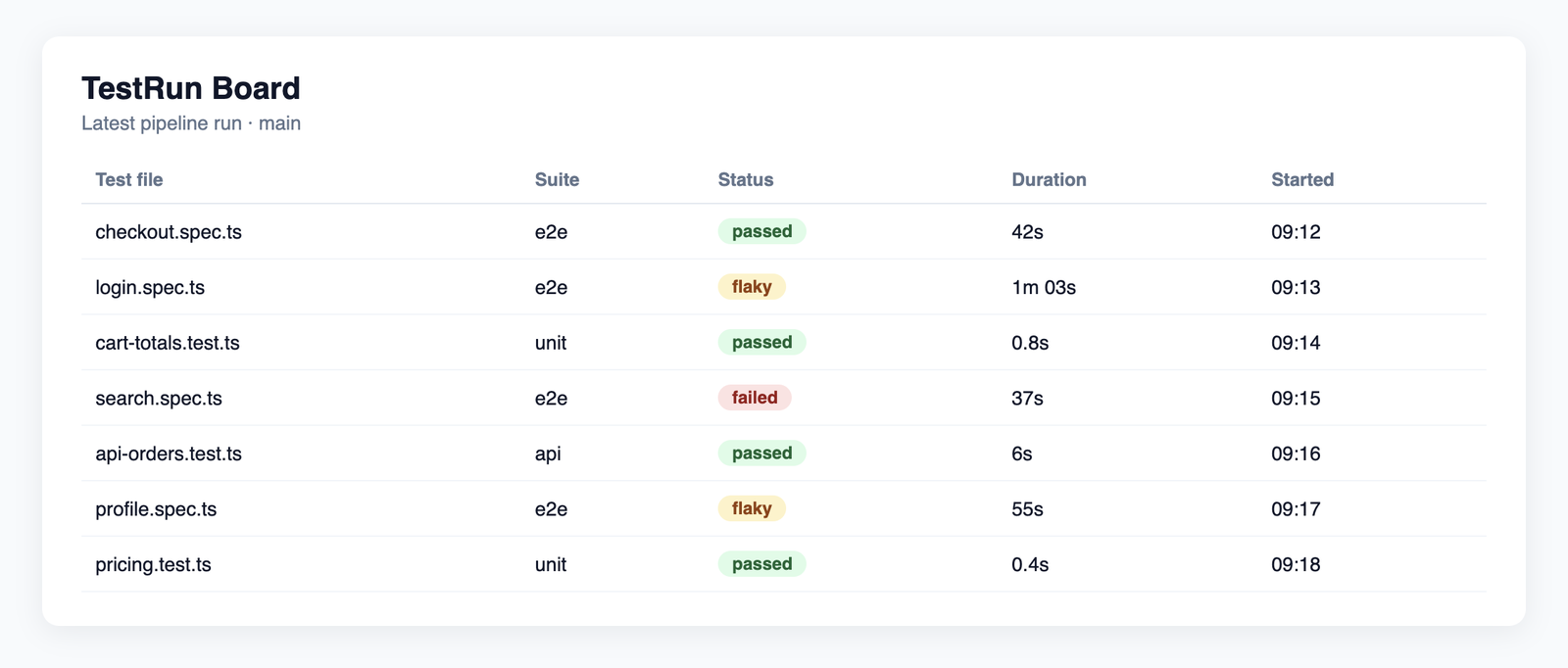
- Real output, not slides. The screenshots show the real app, real test runs, real hook messages and a real CI run.
📦 What you get
This self-paced course takes you from your first feature built with an agent to a quality pipeline your team can adopt. You can follow every exercise in your own repository as well.
🎯 What You’ll Learn
- Deliver a working feature with an agent, with tests, hooks and CI green from the first commit
- Structure context with CLAUDE.md, AGENTS.md, rules and imports so the agent follows your conventions
- Write your own skills and decide when something belongs in a skill, a rule or a hook
- Connect MCP servers, including Playwright MCP, so the agent can test in a real browser
- Recognise the failure modes of AI-generated code: hallucinations, silent regressions and false-green builds
- Practise test-first development with an agent without ending up with tests that only please the model
- Split work across subagents and parallel agents in git worktrees
- Build a repeatable pipeline with quality gates that survives the next sprint
- Compare harnesses (Claude Code, OpenCode, Pi, Hermes) and local models (Ollama, LM Studio, MLX)
- Leave with a governance starter your team can actually adopt
👥 Target Audience
Whole delivery teams adopting agentic workflows together: developers, testers and QA engineers, platform and ops engineers, and engineering managers who want to understand what their team is doing.
⏱️ Estimated Time
16 hours (22 lessons, self-paced)
🧪 Example Project
Every lesson uses the open example repository TestRun Board. It contains everything this course teaches, ready to run: AGENTS.md and CLAUDE.md, permissions, path-scoped rules, skills, a reviewer subagent, hooks, Playwright MCP, specs, property-based and mutation tests, and CI gates with an agent policy check.
git clone https://github.com/learn-automated-testing/testrun-board.git
cd testrun-board
npm install
npx playwright install chromium
npm run check
The main branch is the starting point; worked solutions are on branches such as solution/lesson-02-status-filter. The exercises per lesson are listed in docs/exercises.md.
📋 Prerequisites
- Comfortable with git and the command line
- Node.js 22.18 or newer (or 24.11 or newer) for the example project
- You write features in at least one language (TypeScript, Python, Go or similar)
- Claude Code (or OpenCode) installed, with at least a Claude Pro subscription or API access
📚 Course Modules
Lessons are numbered 1 to 22 across the course: module 1 has lessons 1 to 6, module 2 lessons 7 to 11, module 3 lessons 12 to 16 and module 4 lessons 17 to 22. Cross-references such as “lesson 15” use these numbers.
Screens of the app, test runs, hooks, CI and mutation testing are real output from the example project. Screens of agent sessions are marked as illustrations. All screens were captured with Selenium.
- Foundations: working with a coding agent - What agentic engineering is, your first feature built with an agent, context architecture, planning larger changes, a consistent tone of voice and letting the agent work on its own.
- Extending the agent: skills, MCP, plugins and harnesses - Skills versus rules, writing and editing your own skills, MCP servers with Playwright, plugins such as Caveman and Superpowers, and running the same work in different harnesses.
- Quality: failure modes, TDD, parallel agents and hooks - How AI-generated code fails, test-first with an agent, subagents and worktrees, rules versus hooks, and a lab that ties it together.
- Advanced: pipelines, local models, memory, specs and governance - Chaining agents and gates into a pipeline, local LLMs, persistent memory, spec-driven development, a regression strategy with team governance, and a final end-to-end feature.
Course Modules
Course Info
- Level
- intermediate
- Modules
- 4
- Lessons
- 22